What's interesting, though, is his treatment of images. Namely, the power he associates with them and exactly how they end up doing what they do. In particular, he lists out four steps for how images fare:
1 It is the reflection of a basic reality.
2 It masks and perverts a basic reality.
3 It masks the absence of a basic reality.
4 It bears no relation to any reality whatever: it is its own pure simulacrum.
See, interesting. There's a problem here though. He's arguing that, by being proliferated at a large rate as images are wont, and intended, to do, he argues that they in fact pervert the original material, that they become "more real" while being no more "real" than one's own imaginary friend. Baudrillard even goes as far back as the the Bible to find support, using "l forbade any simulacrum in the temples because the divinity that breathes life into nature cannot be represented" as a springboard for this very discussion. Of course the images can be represented (he argues, perhaps somewhat erroneously), but they would eventually follow the four steps something like this:
1. Images of God adorn places of worship everywhere, are generally accepted as good things
2. It is not considered a place of worship unless there is a statue of God present
3. Despite the presence of a statue of God, there is little worship going towards God, it is instead directed towards said statue, which will now be referred to as "God"
4. All God worship is supplanted by worship of "God", which now refers to itself as Dog and whose maker insists that all places of worship buy exclusively from Statue Co (c) in order to remain wholly solvent
And so, the images have supplanted the reality. In fact, images have long been considered, dare we say, treacherous. See also: The pipe.
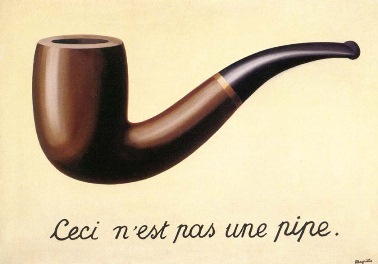
Of course, it's not really a pipe (That's what the French translates to [This is not a pipe.]). It's just a pictorial representation, which is the proper answer. But we automatically, when asked what it is, respond that it's a pipe. The fact that we respond as such to such a simple image can be terrifying when expanded upon. Is the image below real?

It's not, but that's not going to stop it being sent around in a chain e-mail until it becomes so. Is there a spoon?
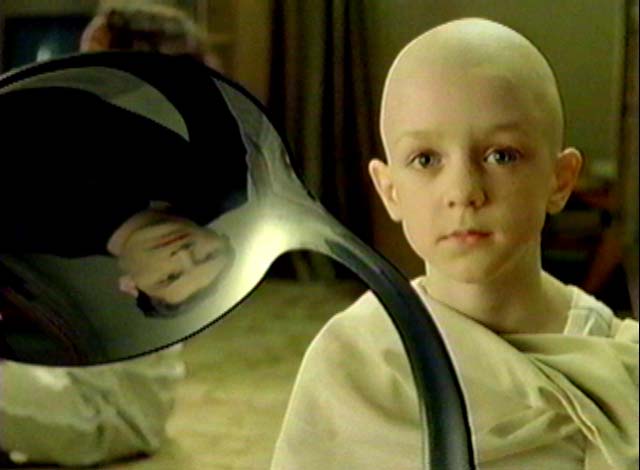
Not really, it's just a movie. But if our reality can be altered as easily, if we can be as easily persuaded that our president isn't actually American or that Sarah Palin is worth listening to, how do we know what's real and what isn't? Is the pipe real? Has the falsehood replaced the reality?


can we separate the two entities? "real" and "unreal"?
ReplyDelete