Tuesday, July 27, 2010

Digital Media Production

Right, before I rightfully begin, I just want to get a bit out of the way because it's been bothering me all day:

I loathe "Choose it yourself" assignments. Now, a large part of this is because I've played enough games in my life that I'm fairly certain I've trained my brain to work better under constraints than with a completely open topic. I actually read a fascinating paper about how, when Grand Theft Auto 3 first came out and players were left with an incredibly open world, their first reaction was to do nothing. I'm like that, except with topics where I have to choose for myself. That's why even the smallest constraint, for example, medium or topic, works best. But that's neither here nor there, and it's not going to change the project in the future. Just something I had to get out.

For this third project, I continually return to a subject that I know fairly well. Now, I know I have carte blanche to choose whatever, but my mind keeps wandering around. I know and love video games, and there are assuredly some very interesting things that could be done with said generalized topic. After all, it's the fastest growing industry of digital media since... well, pretty much anything. It's important to recognize it, I think, and it's one of my expertises (Along with useless 80s trivia, useless 90s trivia, and a surprising amount of free time). And  this, in part, brings me, in a round about way, to my topic.


Identity in gaming is a volatile thing. Unlike nearly every other pursuit of entertainment, you're never locked down to one identity for fairly long. Sure, you may have an avatar, but you're not with it forever and always, as we are with our mental/bodily state. As such, it's a fairly important thing to consider, and it's exactly what I keep coming back to. I want to, at the very least, illustrate how gaming has changed.

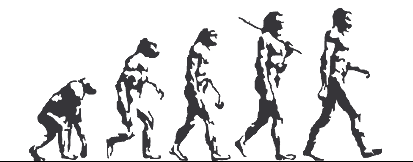
Doing so is the fairly simple part. The image above is a rough copy of the Evolution of Man, a fairly famous illustration showing the evolution of man. My idea was to take the basic tenets, begin at the earliest stages, and then build up to the modern day. The only difference was I'd be using video game protagonists. An image like this could serve two purposes: One, pure entertainment. Not the.... loftiest of ideals, no, but there is something to be said for it. Or, and this is probably better, I could use it to illustrate changing perceptions of games through their protagonist, and I could take a batch of characters per level (So Pac-Man, Space Invader, @, etc for the earliest stage, and then work my way up). Seeing how gaming has evolved (or devolved) over the years in a manner like that could be interesting.

To spice it up, I could actually probably turn it into a video, or something with movement, like a prezi. And I just noticed that we don't need a whole huge thing. On the other hand, I feel somewhat better now I guess?

So right, topic: Identity in gaming as explored through the protagonist character model(s).

Monday, July 26, 2010

First off, I have to wonder if this book is using the basis of Tech's Enterprise program as the frame for the first chapter. I realize that Tech isn't the only school with an Enterprise program (maybe), but the story seems like something that would happen at Tech. (The fast car enterprise should have mentioned that they needed alternate views on their projects that they couldn't supply while talking to the women. They would not have known this.)

That said, not all enterprises are the same, and the one I worked at seems to have read this book. This uses a very rhetorical approach, one that is very methodical. All the steps you need are laid out, and all the steps needed are fairly easy to understand. This is also a system that would help in a big way with pretty much all STC classes. We do hit on a similar system, at least for those who like systems. I'm not such a fan, myself, but even I follow a method that's pretty much the same.

Thursday, July 22, 2010

Copyright: Constantly shifting monstrosity since forever

Well, let's get some things out of the way. I've pirated games. I've downloaded shows, potentially illegally. I used and enjoyed services such as Ninja Video before they got taken down. Just this evening, I sussed out copies of the entire Scott Pilgrim series in anticipation of the movie, just so I could see what I was getting excited about.

(Seriously though, as an aside? I also ordered every one of the collections tonight, it's that good. Scott Pilgrim is the best love-fight-coming of age-NES era referencing comic of our generation. The original is incredibly good stuff, and the movie looks like it's going to feature a surprisingly competant Michael Cera. Plus it's by the guy who made Hot Fuzz and Shaun of the Dead. I don't  believe I can say no to this movie.)

Right, copyright. I can't really say that I'm on the right side of the law. What's worse? I, for all intents and purposes, agree with copyright law.

Now, I'm not necessarily for everything it's for. Artists, authors, and creators should get money for the difficult work of creation. There is no doubt in my mind that this is true. However, current copyright law has the time limits on something like lifetime plus 75 years. That's entirely too long, in my opinion. True, the creator's family deserves some recompense. But the overall creative market could do with some fresh infusion of existing works and archetypes.

Interestingly, the internet skirts around some of the regular copyright. Most notable in these skirting attempts (that's still legal anyway) is the Creative Commons license. With it, an artist can personally pick exactly how they want their work used by the public at large. For example, Jonathan Coulton has it so that his works can be used freely, so long as he's accredited accordingly.

And honestly, I can get behind Creative Commons. Artists still get paid, and the ability to leapfrog off of existing pieces is still available. At the very least parody laws exist. And I don't want to consider an alternate universe where they don't exist, because then we'd be without this:


And that would be terrible.

Tuesday, July 20, 2010

Rough Draft of paper

Note to self: Articles currently hyperlinked with a bit in the text later so I can add in proper MLA formatting. Whatever that means.
------------------------------------------
Technology has a way of changing society and the way things are done. A written language changed how we remember things. Mass printing changed access to information. High speed communications changed the speed with which we could access information. Each of these innovations have, over time, redefined exactly how people define knowledge, literacy, information, sharing, and even community. Without these vital technologies, humanity would still be banging two stones together to create fire while making guttural sounds to warn others of impending danger.

It should be noted, however, that technology hasn't decided to just stop. Instead, technological advances continue trudging forward. Computers have, in recent years, taken all of the previous advances and placed them in one relatively convenient package. Prices have been dropping for entry level machines, high speed internet access has been expanding in markets across the world, and questions are being raised. Namely, how should these new technologies be incorporated into existing structures. Computers have, over the past four decades, wormed their ways into the existing hierarchies to the point where most corporations would be lost without the digital machines.

However, education is not one of those areas. While computers do inhabit more classrooms, and more and more classes are taking place at or around desktops, a good majority of schooling is still done using books, with notes that are taken by more manual means. In fact, despite the recent ubiquity of portable computing, including numerous models of laptops, netbooks, and tablets, many class rooms and professors are banning these machines. An article in the Washington Post noted: "Krahel plans to ban laptops from his classrooms, despite using his as an undergrad -- or perhaps because of it. He admits to getting caught up with distractions on his laptop and realizing what a waste it was, either because of a poor grade, "having to do a lot of catching up on my own time, or asking for other people's help." (WASHINGTON POST) However, if these machines are growing in ubiquity, should educational institutions restrict a students access to the machines? Or should schools instead foster an enviornment where access isn't restricted, and is in fact encouraged to help teach literacy in the new world?

Wednesday, July 14, 2010

Second fun thing of the day

So in my essay I posted.... a weekish ago? I discussed a little bit about how YouTube's set up was conducive to the spread of internet culture. Enter Quietube, a website that plays YouTube videos.... without comments, sidebar, search bar, logos, descriptions... Basically it plays only the videos. The existence of such a thing is interesting, I think.

I write like: Stephen King (Seriously?)

This is almost completely off topic of anything, but the other day I was introduced to one of the coolest (and most infuriating) websites I've ever had the (mis)fortune of discovering: I Write Like...

Not only can it look at anything that's as short as a few paragraphs, but it has a maddening number of authors stored up. The last blog entry (and somehow most of my political pieces as well) apparently shares similarities with one H.P. Lovecraft. Casual blog entries? Douglas Adams. Entirely too many pieces for my own good? Dan Brown. That last one burns, by the by.

However, I've also been told that I write like Margaret Atwood, Vladimir Nabokov, and even Tolkien. The worst part is that I'm not entirely sure how it works or what its criteria are. I would love to crack into its algorithms, break into its black box and see what makes it tick. Alas, that dream is likely not to pass. Sigh.

Again with the literacy

This previous spring semester, I took a course on literacy. While I'm not entirely clear on exactly what was accomplished (aside from much writing), we spent a lot of time focusing on the idea of "literacy". Everything about literacy, from its historical basis to its modern connotations to what exactly to how different individuals from different social classes/time periods have used it. Really, a fascinating study.

And here I find that I am reading, once more, about literacy. Though less about literacy and more about "fluency". Namely, the report author believes literacy to be too limited, that literacy is the expert that stands still and dies off (Thanks for the metaphor, McLuhan!), whereas fluency is the ability to take a set of skills and apply them elsewhere, even in areas that aren't necessarily related. Personally? I don't really see the difference. As far as I'm concerned, Literacy is the ability to learn and communicate effectively. One can never be fully literate, fully versed in any living language. And as easy as learning Latin would be, no one speaks it, so you can't really communicate. Literacy is, in my mind and in most of the reports' mind, a fluid, amorphous structure that is many things at once.

I find it funny that he establishes that there are forms of communication that are not "literacies", as if implying that there are forms of communication that we don't have to learn to communicate in. I'm not entirely sure what he means there. After all, what we know as text are really nothing more than squiggly images of ideas we collectively understand. And we have to learn how to interpret various visual cues, such as a red sign (Stop!) or a green light (Go!). Without learning these things, I would be lost in the modern world I happen to inhabit. The same applies to other images, body language, inflection, scent, touch, etc. We live in a world rich in sensory input coded information. Why do we focus so much on the written language when there are other learned means of communication?

Tuesday, July 13, 2010

I have a rather.. tenuous relationship with my father. He is very much of the old guard. Not necessarily a technophobe, but he doesn't really understand it. For example, we've always had a PC in our home. That PC, for the longest time, was an IBM box that only ran DOS. That didn't deter me from playing games on it, sometimes awful though they were. He saw the machine as a tool, something to be used for taxes and word processing, if you were lucky. Honestly, I'm probably lucky that he let me futz about with DOS so much.

This does expand into more areas than just technology, though. Another prime example is how we put things together. He will read an instruction manual cover to cover before he even so much as touches the base components. Me, I've put enough things together in my lifetime that I can at least look at what's included and make some (educated) guesses. And if I'm wrong, I can live with that! And I can look on YouTube to see what I did wrong. Or Google. Or WikiHow. Basically, anywhere except the actual place I'm supposed to be looking.

So I completely understand the Digital Natives vs Digital Immigrants debate. It's something I've had the (dis)pleasure of experiencing in my own personal life. What's more interesting, I think, is noting that I don't believe that we necessarily know more than previous generations, thus failing their "intelligence" metric. Instead, and far more useful in our day and age, we know how to find it. How often have I been asked to find something, only to find it minutes later in a Google/Wiki/IMDB search? Far too often, but my father isn't the one with those skills.

I am.

Monday, July 12, 2010

The make-up of the internet is a fairly problematic issue. After all, we're all anonymous, to a certain extent, so clearly race isn't an issue anymore, right? Unfortunately, that's probably about as far from the truth as is possible. In a world where a rascist organization holds the name of one of the greatest civil rights leader with little to no indication as to who's hosting the material, we have issues.

As for myself, I find it difficult to really see past them, even beyond race. To me, the amorphous structure of the anonymous masses sitting across the keyboard from me does have a shape. I, personally, see them as largely white and largely male. This is due to the fact that in my years of use of the internet, that just happens to be the make up of people I've actually "met". I have preconceived notions of everyone on the internet, regardless of how true they are. As much as groups such as 4chan's anonymous wish to believe, they are not a faceless organization.

Unfortunately, this is also a rather difficult problem to solve. Blackmon discusses how the major problem is lack of access and education in the digital arts that prevents minorities from really "grabbing" the internet. This is fairly difficult to deal with though. I'm not saying it shouldn't, but to truly get a change that's more than just superficial, we'd need a societal change as well. I do believe that's happening, but society does not change or adapt quickly. Minorities still have a long way to go.

Thursday, July 8, 2010

Now go home and be a family man!

The internet is full of two things. First, it is full of some very, very talented people. As a corollary, it is also full of some very, very bored people. One can imagine that this has led to some very... interesting examples of exactly what a group of people interested in roughly the same thing do with their free time. This creativity can be applied in a multitude of ways. Entire portions of the web are dedicated to writing, whether original or based on pre-existing creations; games, again in a home grown and fan-based flavor; and videos, again in the same varieties.

What is most interesting about internet culture, at least as much as it exists, is how it cyclically picks up on "new" and interesting fads and brief flashes in a pan. As an example, look at The Guile Theme Goes With Everything, a relatively recent YouTube meme that has spread like wildfire. According to the meme archival website Know Your Meme, the first video appeared on Youtube on April 24th, and since then has continued to accrue various iterations both from the originator of the meme and from other, unrelated sources. Over this incredibly short time frame, there were enough submissions by various YouTubers to fill a playlist with 110 different selections. Suffice it to say, Guile Theme Goes With Everything has picked up. Creating a Guile Theme Goes With Everything video is fairly simple as well. To do so, one finds a video clip that does not feature the Guile Theme. Then, you add in the Guile theme and you upload the finished video to YouTube. It's all very simple.

However, most of it is relatively inconsequential. The videos could be about anything, such as short mash ups of game related sound effects with visuals. No matter how you cut it, these videos are all purely digital media. Digital Media, as defined by Manovich in The Language of New Media, is that which is digital, but also entirely digital. Unlike Gitelman in Always Already New, Manovich does not agree that merely digitizing old media automatically transforms it into new media.

What they would agree on, though, is that Guile Theme Goes With Everything videos are prime examples of digital media. They take old and pre-existing, yet digitized, media artifacts, and completely changes them with the introduction of a second artifact, creating a new composite. The original bases, that is the independent video clip and theme may or may not be digital media depending on which author you agree with. The final version though, is. The videos offer a certain modularity, where the original tidbits retain their old structure and uniqueness while the original ingredients remain untainted. Adding the Guile Theme to a video clip of a puppy does not completely overwrite the original video, as it would had the videos been done using old media. Instead, the merging creates its own unique structure, which can then be taken by someone else or viewed by someone else without inherently changing. This ability to change without using up the reactants are inherent to digital media, Manovich has argued. Gitelman argued that by the very act of being uploaded digitally, the components of the Guile Theme Goes With Everything videos had been changed. The fact that the components would later be assembled into something else is almost periphery, they had always been digital media.

So the digital videos on the website YouTube have always been digital media. Not a great surprise. What is most interesting about the Guile Theme videos, though, are what they say about internet culture in general, and meme adoption in particular. Consider, for a moment, the timeline for Guile Theme Goes With Everything. In two months, over 110 different videos from a number of different sources were created and proliferated across YouTube. That's a fair amount of videos in a short amount of time, but then it's not entirely unexpected. In a blog post dating back to November, 2008, Andrew Sullivan noted just how interactive this particular digital medium was. Commenters could, at any time, go through and write comments, adding to any given story or post with their own feedback and views. This kind of interactivity has only increased as well, with Twitter and Facebook allowing for link sharing and the dissemination of information that some of your friends may not even see. Through a series of hyperlinks, tweets, and Likes, one can share information first, second, or third hand, and that information could theoretically continue being shared.

This link sharing phenomena isn't necessarily unpredicted, though. Back in 1945, in an article discussing technology and one theoretical future could end up changing how we think, Vannevar Bush posited a peculiar machine that we're all roughly familiar with: The Memex. Basically, it's an ancient machine that would create hyperlinks between two or more related microfilm recorded documents, allowing you to quickly flip along a line of documents. While the machine was never created, per se, the idea of hyperlinks has caught on in the modern day internet. In fact, Bush even posited that it would be possible to share hyperlinks among friends, building a database of related materials to further human understanding. Obviously, in addition to enhancing understanding of a specific piece of information and whatever's tangentially related to it (a la Wikipedia), YouTube uses a variation of this to spread videos, as in the "Related Videos" sidebar. Through that, any video even tenuously related to what you're watching now has a chance to be listed, and that sort of Memex-like behavior can be a huge boon to budding memes (as with the Guile Theme Goes With Everything). Through the Related Videos, other users can see examples of what others have done, and can have their own work featured. It is through these videos that others can find and see other examples of the meme in question, and can then add to it or help spread word about it. As such, the video builds virally, spreading throughout the various spheres of influence until many other people know about it. Not everyone knows about how the Guile theme goes with everything, but how many people know about Rick Rolls? The Numa Numa song?

The Guile theme goes with everything, whether your video is of a pair of men being tazered or of a cartoon man trying to remember how to ski. More importantly, Guile Theme Goes With Everything is a view at just how quickly word can spread. From a tiny 22 second video, a veritable meme with over 110 entries has sprouted, each easily accessible to the thousands of people who actively find them, who can then go out and spread the word about them. This viral nature of memes is an incredibly important piece of the internet today, and it's young digital artifacts like Guile Theme Goes With Everything that best embody the viral nature. Those deep into the internet pick up on budding memes, and then spread them outward, establishing a verifiable culture that anyone can participate in. Now that, that's something that a particular character's theme song could go with.
Wednesday, July 7, 2010

Sent from my iPad

First off, a few things to uh.... grease the thinky processes. This particular post is going to center largely on Marshall McLuhan and whatever else strikes my fancy that's tangentially related (perhaps the tagline on Apple products denoting what device it was sent from). So, to get the process started...

Part one of The Medium is the Massage record, up on YouTube. Warning: It's twenty minutes long. Additionally, I personally find it hard to follow sometimes. Perhaps that particular medium is not my uh... ideal educational method. It's still cool though.

Second, and most importantly, the Marshall McLuhan website, a little corner on the great series of tubes dedicated to the one man who probably would have appreciated all the little things it does more fully than those who live on it. He may not have known it, but his book largely predicted the internet. Huzzah for him.

So then. Over the weekend, specifically, last Thursday, I picked up an iPad. Now, normally this kind of self-indulgent blogging would be saved for something that actually had an audience, where I would likely either be derided as an Apple loving so and so (which is not a lie), envied (and I would envy myself were the situation reversed), or chided for having too much money and not enough brains or spending money that I rightfully probably shouldn't be (again, both options are likely right on the mark). However, this is a prime example of what McLuhan was arguing about, and I'm going to say that I picked it up to prove a point. Not because I happened to find myself in an Apple store and had that final barrier broken down (IE: Having actually used an iPad for more than five minutes at a time). Regardless, I now have an iPad, and a growing credit score.

So here's the thing. Much like in McLuhan's day, when the TV was rising to prominence as the One Social Media to rule them all, we again find ourselves in a transitional period. One that's lasted for over twenty years now. Way back when, the dominant form of communication was speech. These people thought differently, acted differently, and placed different emphasis on different ideas. Then, the written language came into being. McLuhan notes that text added a strict structure and linearity to thought, a symbolic representation of what had once been ephemeral and omnipresent. Now, thoughts that were deemed as worth keeping around were written, and the higher up a thought was kept, the more important it was. Written languages have arguably been the single greatest invention of the human mind, a complete game changer in a world where there was nothing like it before.

Text would continue dominating, although it would not go uncontested. The radio brought back the potential for high speed vocal communication, potentially bringing back a more sound-oriented society (it didn't). The telephone allowed people to speak with one another whenever they wanted to. The television actually put strangers within your living room, and while you couldn't interact with them, they gave you an entire world you could call your own and have a basis for knowing people at a deeper level (Such as by sharing favorite shows. Has anyone else seen Arrested Development?) Computers initially put the focus again on logical strings of words (C:/DOS
C:/DOS RUN
RUN DOS RUN), but then later shifted to a more visual manner of communication through GUIs. GUIs don't always make sense to every viewer, but those who use them adapt or die. In this case, 'die' means lose all your data and slam your head against the coffee table when you can't find that one very important report that you really, really needed five minutes from now. The internet took computers, and phones, and television, and smashed all of humanity inside of itself in order to create a terrifying frankenstein of all the media that had come beforehand and appear as something completely different.

And finally we've laboriously made our way to my point. Up until a few years ago, the internet was delivered in a manner that was deemed as relatively safe. It was sequestered to the domicile, the office, or to the laptop for the rare person that actually had one. The internet was safely locked away from the rest of the world, and it showed. Then, in June of 2007, Apple released the first iPhone. Suddenly, in addition to making relatively subpar phone calls, you had the internet at your fingertips. And not the specialized internet that Blackberries had been offering, where it was largely sequestered to text based affairs in the nether regions of news-sites and others who offered a gimped service, no. This internet had images. Videos. Funny men doing funny things. With few exceptions, if you could do it at home, you could do it on your brand spanking new iPhone. And consume people did. In a recent report, Quantcast noted that mobile web usage was up 110% in the US in 2009, 148% worldwide. Suddenly, we have a new medium (mobile web) that's delivering old medium (internet) information.

Which finally brings me to the most problematic phrase, "Sent from my iProduct". On the surface, it's not much. Upon seeing it, one might think "Oh, that explains any slight spelling errors" and then go over one's preconceived notion of Apple products and their users. It's more than that though. "Sent from my iPad" is a message to people who haven't accepted, who still think of the Internet as a static series of tubes. It may as well say "I've accepted that I don't have to be tied down by power cables and desks." or "I'm not at my desk, maybe, so unless you reply to this e-mail, I probably won't get your message."

Or it may as well say "I've accepted that the medium has changed, and I've begun to change which message I'm accepting. I've joined the Mass Age, with all it's links to the Mess Age. Where are you?"

Or it could just say "Whoops, I don't have a keyboard, sorry for the grammatical errors. By the by, I have too much money to spend on luxury products that can't do everything that cheaper products can AND I enjoy sucking at the corporate teat."

Personally, I prefer the other message.

Tuesday, July 6, 2010

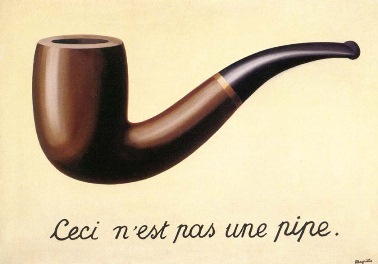
Ceci n'est pas une blog post

So after a fantastic weekend of plays, food, and playing with brand spanking new Apple technology, I'm forced with the unfortunate task of writing about Baudrillard, an article so dense that neutron stars are envious and that I'm not entirely certain I can do justice to in two to three paragraphs. If this runs long, I'm... not really going to be sorry, to be honest. Likely not pleased with myself, but that's life.

What's interesting, though, is his treatment of images. Namely, the power he associates with them and exactly how they end up doing what they do. In particular, he lists out four steps for how images fare:


1 It is the reflection of a basic reality.
2 It masks and perverts a basic reality.
3 It masks the absence of a basic reality.
4 It bears no relation to any reality whatever: it is its own pure simulacrum.


See, interesting. There's a problem here though. He's arguing that, by being proliferated at a large rate as images are wont, and intended, to do, he argues that they in fact pervert the original material, that they become "more real" while being no more "real" than one's own imaginary friend. Baudrillard even goes as far back as the the Bible to find support, using "l forbade any simulacrum in the temples because the divinity that breathes life into nature cannot be represented" as a springboard for this very discussion. Of course the images can be represented (he argues, perhaps somewhat erroneously), but they would eventually follow the four steps something like this:

1. Images of God adorn places of worship everywhere, are generally accepted as good things
2. It is not considered a place of worship unless there is a statue of God present
3. Despite the presence of a statue of God, there is little worship going towards God, it is instead directed towards said statue, which will now be referred to as "God"

4. All God worship is supplanted by worship of "God", which now refers to itself as Dog and whose maker insists that all places of worship buy exclusively from Statue Co (c) in order to remain wholly solvent


And so, the images have supplanted the reality. In fact, images have long been considered, dare we say, treacherous. See also: The pipe.


Of course, it's not really a pipe (That's what the French translates to [This is not a pipe.]). It's just a pictorial representation, which is the proper answer. But we automatically, when asked what it is, respond that it's a pipe. The fact that we respond as such to such a simple image can be terrifying when expanded upon. Is the image below real?


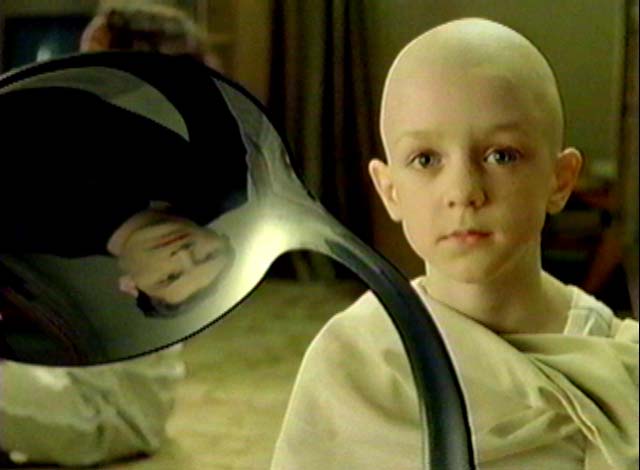
It's not, but that's not going to stop it being sent around in a chain e-mail until it becomes so. Is there a spoon?


Not really, it's just a movie. But if our reality can be altered as easily, if we can be as easily persuaded that our president isn't actually American or that Sarah Palin is worth listening to, how do we know what's real and what isn't? Is the pipe real? Has the falsehood replaced the reality?